

- About Us
- PRODUCTS
- SUPPORT
- Knowledge
- LANGUAGE
Stop Trusting Luck: Build Resilient Data Protection
The biggest mistake in enterprise data protection is putting trust in people instead of architecture.
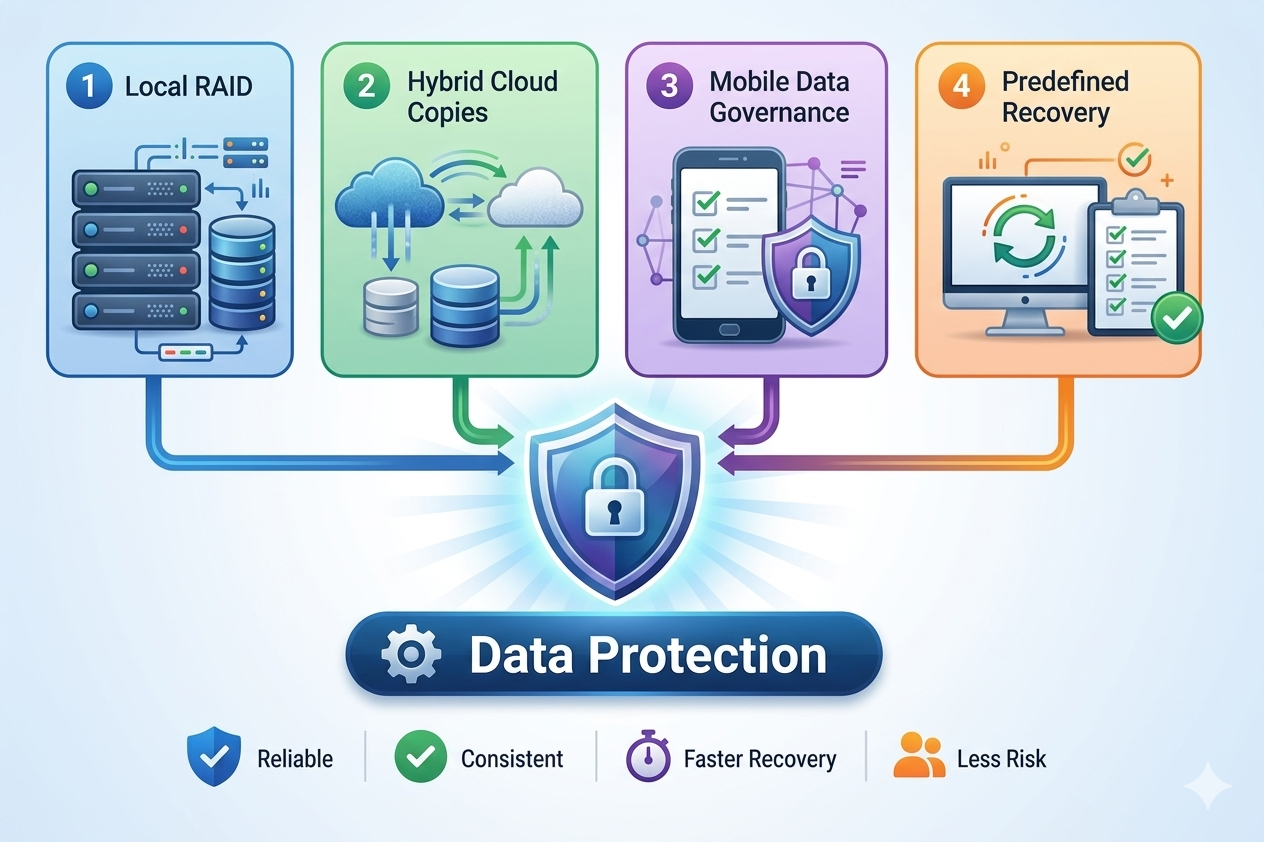
Most organizations approach data protection through process, tooling, and operational discipline.
They deploy endpoint security, add backup software, subscribe to cloud platforms, tighten policy, and ask IT teams to stay vigilant. All of that matters. But it all rests on the same assumption: people will act correctly, networks will stay available, systems will behave normally, and procedures will still be followed under pressure.
That assumption is the root of most protection failures.
Data protection is not truly tested when everything is healthy. It is tested when the network is down, a disk fails, ransomware hits, a host becomes unstable, or someone makes a mistake. In that moment, the real question is not how many tools were purchased. It is this: what remains in the architecture that can still function without perfect human response?
The real measure of enterprise data protection is never how complete it looks in normal conditions.
It is whether the lower layers still deliver results when the upper layers fail.
1. Resilience Is Proven Under Failure
In normal conditions, most environments appear reliable.
The network is up, permissions are correct, backup jobs are running, cloud sync is healthy, and every protection layer seems to be functioning as intended.
But normal operation proves very little.
What matters is not whether backups run on a calm day. What matters is whether, under failure, the environment can still:
In practice, how much data a business retains, how quickly it recovers, and how long it stays down are not determined by procurement lists alone. They are determined by the default behavior of the storage and protection architecture underneath them.
What many organizations lack is not another product.
It is a structure that can still hold the line when conditions deteriorate.
2. Data Protection Cannot End at the Management Layer
Governance, policy, training, and access control are all necessary.
But they should not be the final line of defense.
Management assumes people will continue doing the right thing.
Architecture assumes that even when people fail under pressure, the system should still reduce the blast radius and preserve a recoverable state.
These are not competing ideas. They are different layers of the same strategy.
A mature IT environment does not build protection around the hope that nobody makes mistakes. It embeds protection in the foundation so it is already present before something goes wrong.
Durable data protection is not built on correct behavior alone.
It is built on systems that are protective by default.
3. RAID, Local Storage, and Cloud Solve Different Problems
One of the most common mistakes in enterprise data protection is treating different technologies as if they were interchangeable. They are not.
RAID, backup, offsite copies, and cloud synchronization each address different forms of failure. Confusing them leads directly to design gaps.
What RAID Solves
Using RAID 5 as an example, its value is not that it “is a backup.” Its value is that it can:
RAID is fundamentally about availability and fault tolerance.
What RAID does not solve includes:
So RAID matters, but it is only one layer of protection, not the entire model.
What Local Storage Solves
A local storage system with RAID capability delivers value by:
This is particularly important in ransomware recovery, large-file restore scenarios, edge locations, and environments with unpredictable network quality.
What Cloud Solves
Cloud platforms and cloud copies are strong at:
But cloud still depends on:
Cloud is excellent for offsite resilience. It is not automatically the best or only recovery path for every failure scenario.
The role split becomes clearer when stated directly:
Availability = RAID
Recovery Speed = Local Storage
Offsite Resilience = Cloud
These are not substitutes. They are layers.
4. Protection Should Be a Default Behavior, Not a Real-Time Decision
Many protection failures do not happen because tools are absent.
They happen because too many critical actions still depend on someone making the right decision at the right time.
For example:
Every real-time decision creates another opportunity for delay, omission, or error.
Every manual step creates another point of friction.
That is why mature architecture does not simply offer tools. It turns protection into default behavior:
The goal is not to make teams work harder.
It is to reduce how much must be decided under pressure.
5. Local RAID Storage Is Not Just Capacity — It Is the Bottom-Line Node in a Hybrid Architecture
In hybrid cloud environments, one of the most common design mistakes is treating the cloud as the endpoint of protection.
In practice, cloud often works best as the offsite copy layer and orchestration layer, not the only place recovery starts. That is where local RAID-backed storage stops being “just a storage box” and becomes a bottom-line recovery node inside the protection architecture.
Its value typically appears in four ways:
1. It Serves as a Local Backup and Restore Target
It can receive synchronized cloud data, host-level backups, or department-level shared datasets.
If external connectivity is degraded, the business still has a readable, restorable, movable local copy.
2. It Adds RAID-Level Fault Tolerance
When a single disk fails, the environment can remain operational and avoid turning a hardware event into an immediate outage.
That is not zero risk, but it keeps common hardware faults inside a manageable boundary.
3. It Reduces Dependence on External Conditions During Recovery
If usable copies exist only in the cloud, recovery speed depends on bandwidth, routing, platform health, and identity access.
A local RAID node provides a nearby restore point, which matters even more for large datasets and low-downtime environments.
4. It Complements Cloud Instead of Replacing It
Local storage is not an argument against cloud.
It is what compensates for cloud’s practical limitations in outage, latency-sensitive, and high-volume recovery scenarios.
Cloud carries the offsite role. Local carries the bottom line. Together they create resilience.
6. Mobile Data Protection Should Not Depend on Employee Memory
Enterprise data risk no longer lives only on servers and desktops.
A significant amount of working data now lives on phones and tablets: documents, site photos, customer files, field notes, and temporary edits.
The issue is not employee willingness.
The issue is that as long as protection still depends on “remember to upload,” “remember to back up,” or “remember to organize,” it remains structurally weak.
So mobile data protection is not mainly an education problem.
It is a friction problem.
Tools that support iPhone, iPad, and other mobile endpoints matter not because they add another app, but because they bring scattered and easily missed data back into the existing protection architecture. They move mobile handling away from voluntary behavior and toward default behavior.
This reduces:
For the organization, that is not just convenience.
It is the closure of another high-risk gap in the protection model.
7. A Mature Strategy Must Be Clear About What It Solves — and What It Does Not
The solutions that earn trust from IT decision-makers are not the ones that claim to solve everything.
They are the ones that define their scope clearly.
This architecture delivers value by:
But it should not be interpreted as claiming that:
What enterprises need is not a single myth.
They need a structure in which different layers absorb different kinds of failure.
Conclusion: Stability Comes From Structure, Not Tool Count
The maturity of enterprise data protection is not measured by how many tools an organization owns.
It is measured by whether, when one layer fails — tool, process, person, or network — another layer is still present to absorb the impact.
Data protection is not about how many tools you have. It is about how many mistakes your architecture can absorb.
That is why the real bottom line cannot be built on assumptions that teams will never make mistakes, networks will never fail, licenses will never expire, or cloud services will always be available.
The real bottom line has to be built on structure.
When local RAID storage, hybrid cloud copies, mobile data governance, and predefined recovery behavior are designed into the same model, data protection stops being a management demand and starts becoming an engineering property.
Real data protection is not about preventing failure. It is about ensuring that when failure happens, the system still delivers results.
Resilience is not an outcome. It is a design choice.
Systems fail. Architecture decides what happens next.
Resilience is engineered, not hoped for.
| Return |











RaidonTek.com (stardom.com.tw) uses cookies to improve site functionality and your overall experience by storing necessary information for service delivery. By continuing, you consent to our use of cookies as detailed in our Privacy Policy, which provides more information about this usage. (Accept cookies to continue browsing the website)
 English-US
 Chinese Traditional
 Japanese
 Korean
 Russian
 German
 French
 Chinese Simplified
 Spanish
 Italian